
The Science-Backed Guide to Anti-Aging Skincare for Women Over 40 That Actually Works

Reviewed by Sarah Mitchell, Beauty & Wellness Research Editor | Last updated: March2026
That Morning You Looked in the Mirror and Something Had Changed
You remember the morning. You weren’t sick. You hadn’t done anything differently. But you looked in the mirror and felt like your face had quietly shifted overnight, a little less firm around the jaw, a little more tired around the eyes, a texture that felt drier and duller than you remembered.
If that moment feels familiar, you’re not imagining things. And you are absolutely not alone.
Millions of women describe this exact experience, usually somewhere between their late 30s and mid-40s. What most of them don’t realize is that this shift isn’t random, there’s a precise biological reason it happens, and once you understand it, the right anti-aging skincare for women over 40 skincare decisions become much clearer.
This article will walk you through the science of what’s actually happening to your skin, which ingredients genuinely work, how to build the best anti-aging skincare for women over 40 that makes a real difference and at the end, an honest review of a skincare system that many women in this stage of life have been exploring in 2026.
No hype. No miracle claims. Just the truth and what you can actually do about it.
The Real Reason Your Skin Changes After 40
Most women are told that skin aging is simply about getting older. That’s true, but it’s not the whole picture. For women specifically, there is a hormonal driver that goes far beyond chronological age: estrogen decline.
Estrogen doesn’t just affect your reproductive system. Your skin is full of estrogen receptors, particularly on fibroblast cells, the specialized cells responsible for producing collagen and elastin. When estrogen levels begin falling (a process that starts gradually in your 30s and accelerates sharply during perimenopause and menopause), those fibroblasts slow down.
The numbers are stark. Research published in dermatological journals has found that women can lose up to 30% of their dermal collagen in the first five years after menopause, followed by an additional 2% decline every year after that. That’s not a gradual, barely-noticeable change, it’s a structural shift in the foundation of your skin.
The result? Skin that is thinner, less firm, drier, slower to heal, and more vulnerable to the visible effects of UV damage and environmental stress.
“The decline in collagen content in women parallels the reduction in bone mass seen post-menopause and it correlates more closely with the period of estrogen deficiency than with chronological age itself.”
National Institutes of Health, published study on estrogen and skin aging
Understanding this isn’t meant to be discouraging. It’s meant to be empowering. Because once you know why your skin is changing, you can choose ingredients and habits that actually speak to those specific mechanisms, rather than buying whatever promises the most dramatic results on the packaging.

The 5 Skincare Ingredients That Science Actually Backs
Not all skincare ingredients are created equal. The beauty industry is full of trends, buzzwords, and overpromising. Here’s what dermatological research consistently supports for women with mature skin:
1. Hyaluronic Acid (Sodium Hyaluronate)
Hyaluronic acid is one of the most rigorously studied hydrating ingredients in skincare. It’s a naturally occurring molecule in the body that holds up to 1,000 times its weight in water, but its natural levels decline significantly with age.
The sodium hyaluronate form (the salt form) penetrates the skin more efficiently than larger hyaluronic acid molecules, making it the preferred version in high-quality serums. Multiple clinical studies have confirmed its ability to improve skin hydration, reduce wrinkle depth, and increase skin elasticity with consistent use.
2. Peptides (Including SYN-AKE®)
Peptides are short chains of amino acids that function as signaling molecules in the skin, essentially telling your skin cells to produce more collagen. As a category, peptides are one of the most exciting frontiers in non-prescription anti-aging skincare in 2026.
One particularly well-researched peptide is SYN-AKE®, a synthetic compound that mimics the effect of a component found in temple viper venom (safely replicated in a lab) to temporarily relax facial muscle tension and reduce the appearance of expression lines. Clinical evaluations of SYN-AKE® have shown measurable reductions in wrinkle depth within 28 days of consistent use.
3. Vitamin C (Ascorbic Acid)
Vitamin C is a dual-action ingredient: it acts as a powerful antioxidant that neutralizes free radical damage caused by UV and pollution, and it directly stimulates collagen synthesis, one of the key mechanisms that slows with estrogen decline.
It’s also the most effective non-prescription ingredient for brightening uneven skin tone and gradually fading sun-related hyperpigmentation. Formulation stability is critical, Vitamin C degrades quickly when exposed to light and air, so storage matters.
4. Vitamin E (Tocopheryl Acetate)
Vitamin E works in synergy with Vitamin C, extending and regenerating its antioxidant activity in the skin. On its own, it strengthens the skin’s moisture barrier, reducing transepidermal water loss (TEWL), a leading cause of dry, rough-textured mature skin.
The acetate form (tocopheryl acetate) is the more stable version and is the formulation most commonly found in high-quality serums.
5. Niacinamide (Vitamin B3)
Niacinamide has become one of the most versatile and respected skincare actives of the past decade. It supports sebum regulation, minimizes the appearance of enlarged pores, improves uneven skin tone, and reinforces the skin’s natural barrier. Multiple clinical studies also support its role in reducing the appearance of fine lines and improving elasticity over time.
Why the “Inside-Out” Approach Is More Than a Trend
One of the most important shifts in skincare thinking in recent years is the recognition that what you put into your body matters just as much as what you apply to your skin. This field, often called nutricosmetics, has moved from a niche wellness concept into mainstream dermatological conversation.
The science is straightforward: key micronutrients directly influence collagen production, skin barrier integrity, inflammation control, and cell renewal. When these nutrients are insufficient, no topical product can fully compensate.
Biotin (Vitamin B7) supports the metabolism of fatty acids essential for healthy skin structure. Zinc plays a critical role in wound healing, sebum regulation, and anti-inflammatory response and its deficiency is directly linked to skin barrier disruption. Horsetail extract, rich in silica, provides the structural precursors that support collagen fiber organization and skin elasticity. Niacinamide taken internally complements its topical benefits, supporting cellular energy and repair processes.
The most effective modern skincare routines recognize that the skin is an organ and like any organ, it performs best when nourished both externally and from within.
Anti-Aging Skincare for Women Over 40: A Realistic Daily Routine
No product, however excellent, works in isolation. Here’s what skin experts consistently recommend as the foundation for anti-aging skincare for women over 40:
Morning – Protect and Prevent:
- Gentle, non-stripping cleanser (avoid harsh sulfates)
- Antioxidant serum (Vitamin C for daytime free radical protection)
- Hydrating moisturizer with peptides or ceramides
- Broad-spectrum SPF 30+ (non-negotiable — UV exposure is the #1 driver of visible skin aging)
Evening – Repair and Replenish:
- Double cleanse if you wear makeup or sunscreen
- Treatment serum (peptides, hyaluronic acid, or retinol-based)
- Richer moisturizer or facial oil to support barrier repair overnight
Weekly:
- Gentle exfoliation 1–2x per week to support cell turnover
- Hydrating mask for extra moisture recovery
One principle above all others: consistency beats complexity. A simple routine done every day for 12 weeks will deliver far better results than an elaborate 10-step regimen done sporadically. Most active ingredients require 4–12 weeks before visible results appear.
Synevra UltraLift: An Honest Review
“I’ve looked at a lot of skincare systems that promise the world and deliver very little. What I appreciate about Synevra’s formulation approach is that they’ve chosen ingredients with actual clinical literature behind them, rather than trending buzzwords with thin science.”
Sarah Mitchell, Beauty & Wellness Research Editor
With that context in mind, let’s take an honest look at Synevra UltraLift, a Swiss-inspired dual-action skincare system that has been gaining attention in the anti-aging space in 2026.
What Is It?
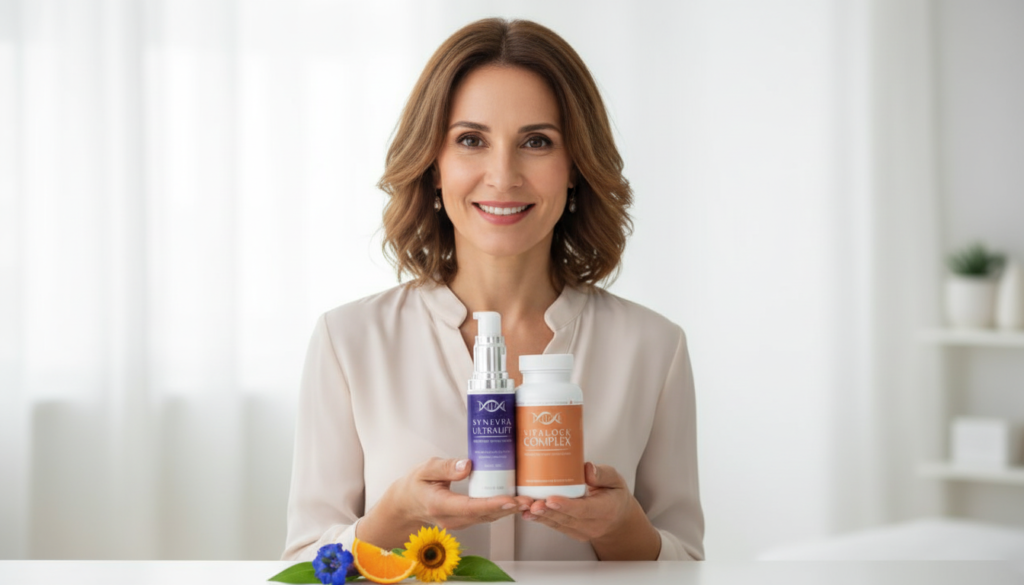
Synevra is a two-part system designed around the inside-out approach to skin support:
- UltraLift Serum Complex: a topical peptide serum applied to the face
- VitaLock Beauty Nutrients: an oral supplement to support skin health from within
The brand’s philosophy is built on the premise that addressing visible aging requires both surface-level intervention and internal nutritional support, a position increasingly aligned with contemporary dermatological thinking.
What’s Inside?
UltraLift Serum (Topical):
- SYN-AKE® Dipeptide Complex: expression line smoothing
- Sodium Hyaluronate: deep hydration and plumping
- Ascorbic Acid (Vitamin C): antioxidant protection and brightening
- Tocopheryl Acetate (Vitamin E): barrier strength and antioxidant synergy
- Glycerin: moisture attraction and retention
VitaLock Complex (Oral Supplement):
- Biotin – skin, hair, and nail metabolic support
- Niacinamide (Vitamin B3) – tone, texture, and barrier function
- Vitamin B6 – cellular renewal support
- Zinc – skin integrity and anti-inflammatory properties
- Horsetail Extract – silica-rich collagen structural support
All ingredients are Non-GMO, paraben-free, and cruelty-free.
Pros & Cons at a Glance
| ✅ What We Like | ⚠️ What to Keep in Mind |
|---|---|
| Evidence-backed ingredient selection | Ingredient concentrations not publicly disclosed |
| Dual-action topical + oral approach | No independent clinical trial on the full system |
| Clean, non-GMO, paraben-free formulation | Results are gradual — not instant |
| Simplifies routine into two products | Supplement benefits may be limited if your diet is already nutrient-complete |
| 60-day money-back guarantee | Available only through the official website |
| Aligned with 2026 nutricosmetics trend | Premium price point |
Who Is Synevra Best For?
Synevra appears best suited for women who:
- Are 35 and older and beginning to notice visible changes in firmness, texture, or hydration
- Prefer a clean, non-invasive approach to anti-aging without prescription treatments
- Want a simplified system that combines topical and internal support
- Understand that meaningful skincare results build over weeks, not days
- Are curious about the nutricosmetics trend and want to experience an integrated approach
What Real Users Are Saying
Customer testimonials shared by the brand reflect gradual, confidence-focused results rather than dramatic transformations — which, honestly, is what you should expect from any legitimate cosmetic skincare product:
“I love how smooth my skin looks. People keep asking what I’m doing differently.” – Virginia R., New York
“Even my dermatologist commented on the improvement in my skin texture.” – Jennifer M., Los Angeles
“At 61, I feel confident wearing very little makeup. It simplified my entire routine.” – Carol W., Georgia
These are brand-provided testimonials. Individual results will vary, and they should be read as illustrative examples rather than guarantees.
Sarah’s Overall Take
“Synevra’s approach is thoughtful. The ingredient list for both the serum and the supplement reflects genuine research rather than marketing trends. The SYN-AKE® peptide in the serum has real clinical backing, and the decision to combine it with a nutricosmetic supplement is the direction the best skincare science is pointing toward in 2026. My honest recommendation: give it a full 8 weeks of consistent use before forming your final opinion. Skin doesn’t change overnight, but with the right support, it does change.”
Sarah Mitchell, Beauty & Wellness Research Editor
👉 Visit the Official Synevra UltraLift Website Here
(Affiliate disclosure: This is an affiliate link. If you choose to purchase, I may receive a small commission at no additional cost to you. This does not influence my honest assessment of the product.)
The Bigger Truth About Skin After 40
There is a version of anti-aging skincare for women over 40 that is not about chasing youth or pretending the years haven’t happened. It’s about understanding your skin with more clarity than you ever had before, knowing what it needs, choosing ingredients that genuinely deliver, and building habits that compound over time.
The women who seem to age most gracefully aren’t necessarily the ones spending the most money. They’re the ones who are the most consistent, the most informed, and the most patient. Your skin at 45 or 55 or 65 has a different character than it did at 25, and with the right care, it can be every bit as beautiful.
FAQ
Q: At what age should I start anti-aging skincare?
Dermatologists recommend incorporating preventive ingredients – especially SPF and Vitamin C antioxidants – in your mid-20s. Targeted treatments like peptides are typically introduced in the 30s and 40s, when collagen loss begins to accelerate.
Q: How does estrogen decline affect my skin specifically?
Estrogen supports collagen synthesis through receptors on fibroblast cells in the skin. When estrogen declines after perimenopause, collagen production slows significantly – women can lose up to 30% of dermal collagen in the first five years after menopause, leading to thinner, drier, less elastic skin.
Q: Can a serum replace my moisturizer?
No. Serums are concentrated treatment products designed to deliver active ingredients into the skin, but most don’t provide the barrier occlusion needed to lock in hydration. Always apply a serum under your moisturizer for best results.
Q: How long does it take to see results from a peptide serum?
Most peptide-based serums require a minimum of 4–8 weeks of consistent daily use before visible improvements appear. Products targeting collagen stimulation, like SYN-AKE®, show measurable results in clinical settings at 28 days, but the full benefit typically builds over 8–12 weeks.
Q: Is the Synevra VitaLock supplement safe for daily use?
The supplement contains well-established beauty nutrients (biotin, niacinamide, B6, zinc, horsetail extract) at levels generally recognized as safe for daily use. However, if you are pregnant, nursing, or taking any medication, always consult your healthcare provider before starting a new supplement.
Q: Is Synevra suitable for sensitive skin?
According to the brand, the formula is designed to be gentle and suitable for daily use including sensitive skin. A patch test on a small area before full-face application is always advisable with any new skincare product.
Q: Where can I buy Synevra UltraLift?
Synevra is available exclusively through its official website, which also ensures access to the 60-day money-back guarantee and any current package pricing.
Q: Do I need to take the supplement AND use the serum, or can I do just one?
Both products are designed to complement each other, but you can use either independently. The topical serum addresses surface-level visible concerns, while the supplement supports skin health systemically. For the full intended benefit of the inside-out approach, using both consistently is recommended.
We’d Love to Hear from You
Skincare is one of the most personal journeys a woman can take, what works beautifully for one person may not suit another, and there’s so much wisdom in this community. Have you tried a peptide serum or a nutricosmetic supplement? Have you noticed changes in your skin in your 40s and found something that genuinely helped? Leave your experience in the comments below, we read every single one, and your insight might be exactly what another reader needs to find her own path to healthier skin.
References
- Brincat, M. et al. (1987). Skin collagen changes in postmenopausal women receiving different regimens of oestrogen therapy. British Journal of Obstetrics and Gynaecology, via NIH.
- Verdier-Sévrain, S. (2007). Effect of estrogens on skin aging and the potential role of SERMs. Clinical Interventions in Aging.
- Journal of Cosmetic Dermatology (2025). Managing menopausal skin changes: HRT and skin quality.
- Wong, quoted in American Society of Plastic Surgeons (2025). The innovation of estrogen-based medical skincare.
- Kim Gallo Esthetics (2025). The best skincare routine for women over 40.
- Vogue (2026). 2026’s biggest skincare trends to try now.
- Pullar, J.M., Carr, A.C., & Vissers, M.C.M. (2017). The roles of Vitamin C in skin health. Nutrients, 9(8), 866.
- Synevra UltraLift Official Website (2026).
- Independent consumer reviews and analysis (2026).